Best Patreats and Army Patterns in Art in the World
Articles and Features
The Fine art of Repetition: Top x Pattern Artists
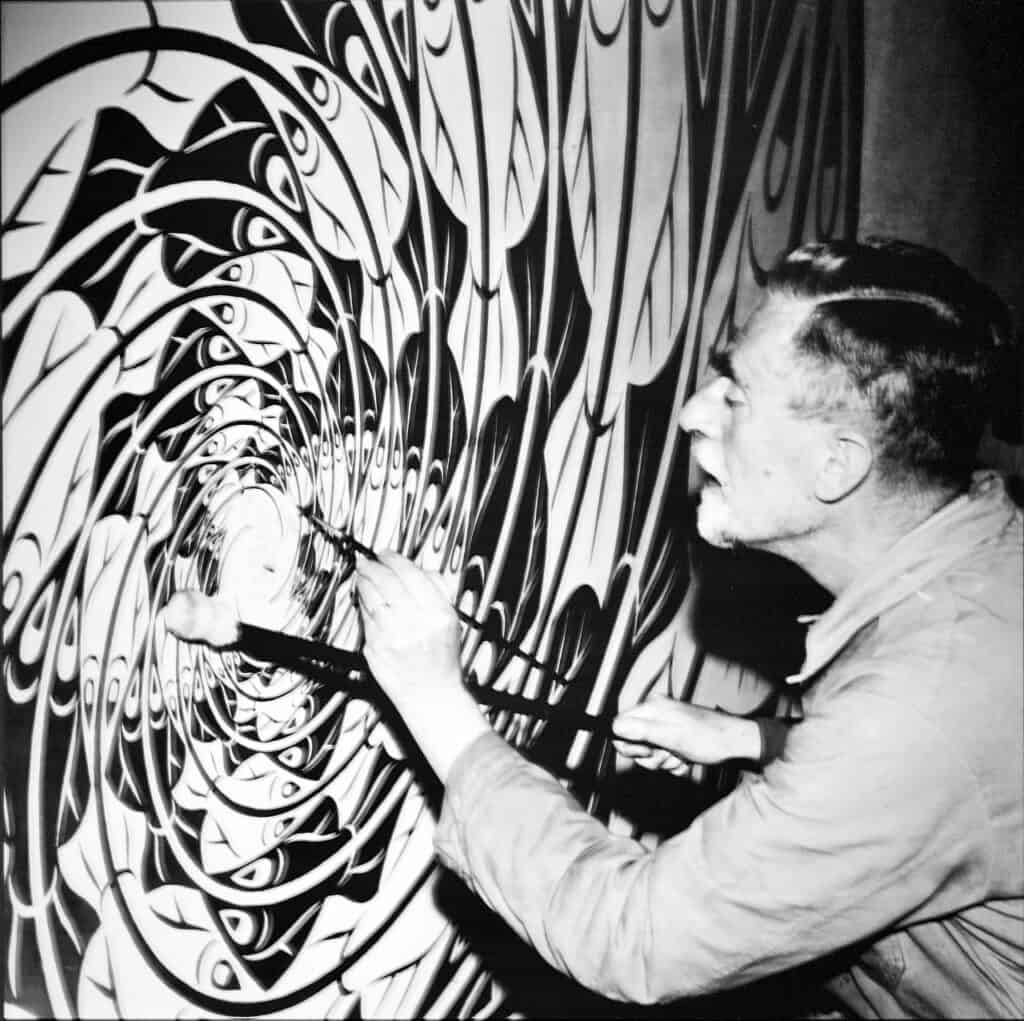
Past Shira Wolfe
"I retrieve yous get meaning through repetition."
Damien Hirst
Repeated forms and regular arrangements have been used in art from ancient times. The simple act of repeating the same unit over and once more creates new narratives and interpretations. From art inspired by aboriginal architectural patterns to the development of serialisation in Op and Pop Art, we highlight 10 pattern artists who used repetition in their art, each in their own different way.
1. Gustav Klimt
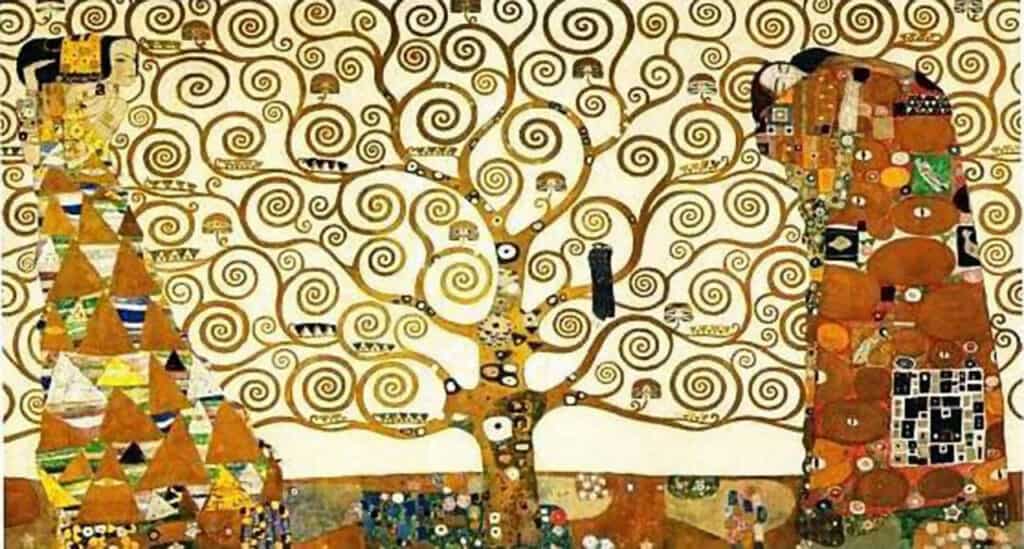
Gustav Klimt, known for his ornate, decorative style and the utilise of luxurious gilded leafing, often used patterns in his artworks. The motifs were inspired by Byzantine, Greek and Egyptian fine art. In The Kiss (1907-8) for example, flat areas of irregular patterns compose the unabridged painting. The man'southward body is created using a repeating rectangle motif, and the adult female's body is composed of circles. In cartoons for the execution of a frieze for the dining room of Stoclet House in Brussels (1910-eleven), we see a recurring swirling motif that makes upward the Tree of Life. The figure on the left side of the tree wears a apparel with triangular patterns, while the figure on the right, in the midst of an embrace, has several dissimilar shapes on his robe: circles, squares and triangles. In fact, even the gold leafing Klimt used and so frequently in his paintings provides a dazzling patterning, conspicuously visible in his Portrait of Adele Bloch-Bauer I (1907).
2. Grand.C. Escher
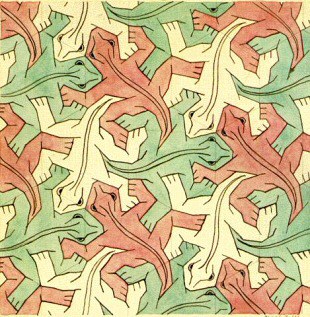
Dutch artist G.C. Escher came to his signature style following a trip to the Alhambra Palace in Granada, Kingdom of spain. He advisedly copied the geometrical tilings covering the facade of the palace and from that moment onward, his artistic production became much more formally inventive. He started to develop art following the principles of tessellation (covering a plane using ane or more geometric shapes, with no overlaps and gaps). At first, Escher explored working with the basic patterns, but then he moved on to work with all sorts of creatures resembling fish, birds, lizards and insects, stemming from his love for the natural earth. Escher arranged his shapes across a flat airplane such that the spaces between his figures would create other recognisable shapes. In these images, the viewer can cull to see 1 or the other set of shapes as the foreground at his or her will.
3. Anni Albers
Born in Berlin in 1899, Anni Albers received her pedagogy at the Bauhaus in Weimar, before moving to the United States where she started to create mass-producible textile patterns. Albers worked with striking geometric patterns and bold colours, helping to pioneer the Modernist movement.
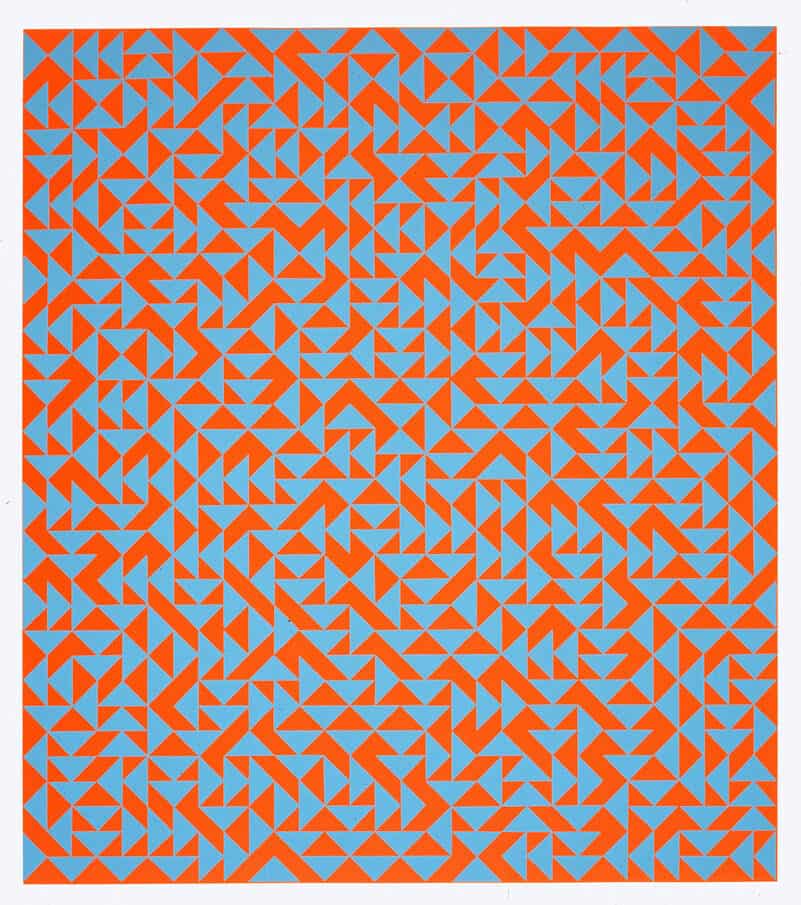
Albers's revolutionary "pictorial weavings" were influenced past Pre-Columbian art and textiles, which she studied during her trips to Mexico in the 1930s and 1940s. In both her textiles and her prints, she created intricately patterned, complex compositions built upon geometric motifs and repeated elements. Later 40 years of creating her iconic woven works, Albers started printmaking in 1963, just when the Op and Pop Art movements were in prominence. In i of her serigraphs, Untitled (1969), we meet a hard-edged geometric composition characteristic of her prints. Hundreds of identical turquoise blue triangles are fix confronting a crimson background, and past rotating private triangles, Albers energised the composition and revealed various red shapes.
four. Andy Warhol
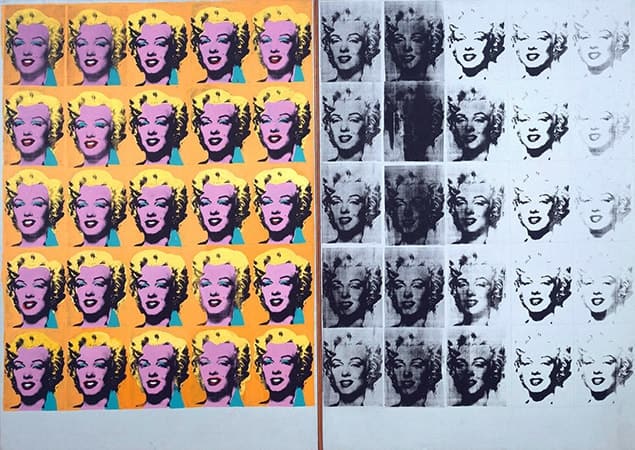
Legendary Pop Artist Andy Warhol is known for working with repetition in his silkscreen prints inspired by the imagery of pop civilisation and mass production but as well worked across a wide range of media besides printmaking, including painting, drawing, sculpture, photography, music and picture show. He became famous for his repetitive images of soup cans, soda bottles, dollar bills, and portraits of celebrities including Marilyn Monroe, Mick Jagger, Elvis Presley and Elizabeth Taylor. He would oft repeat the aforementioned picture in one piece, differentiating between them with diverse colours. In essence, Warhol was creating his ain repetitive patterns, and these became some of the nigh iconic images of the 20th century.
5. Keith Haring
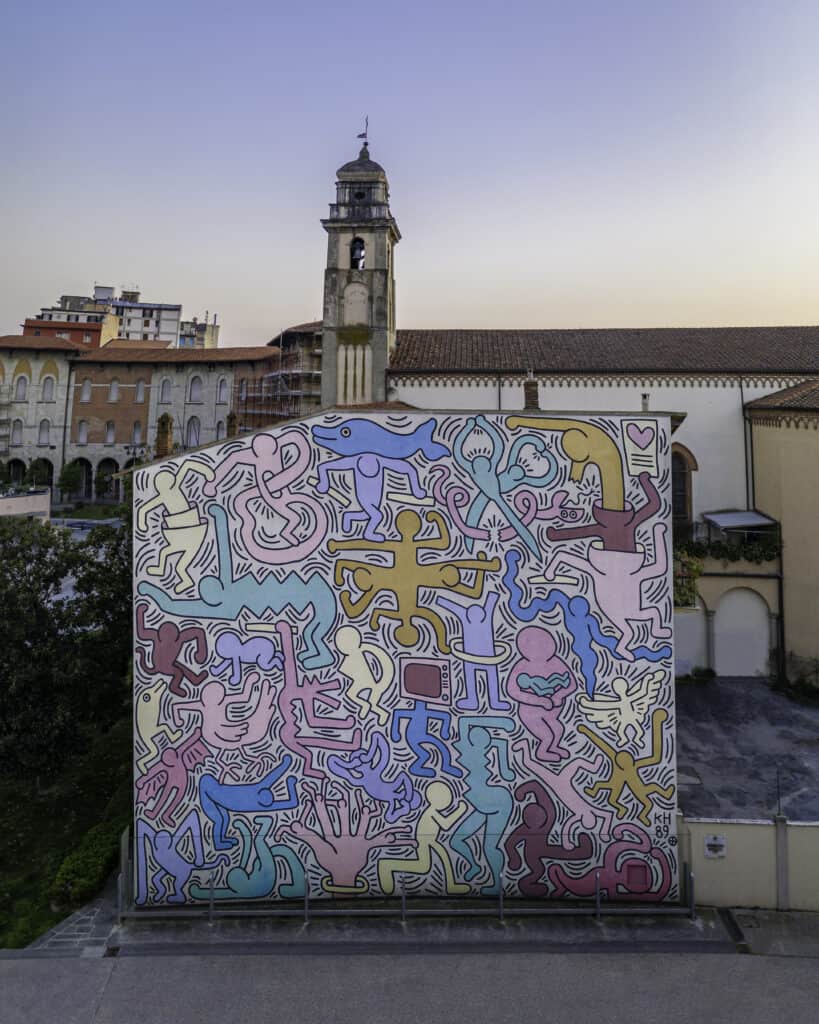
1980s street art phenomenon Keith Haring became known for his graffiti tags of interlocking bodies that he would mark the blackness poster mounts in the New York Metropolis subways with. He presently created a recognisable set of images and symbols that he would repeat over and over once more as enigmatic and colourful patterns, all across town in New York City equally well as in his paintings and prints. Famous Haring themes are his line-fatigued radiant babies, barking dogs and human figures. With the increment of his public recognition, Haring started creating large-scale murals that addressed political and societal issues (like his Crack is Wack mural from 1986), always using his personal iconography and the repetition of these symbols.
"I would cover a canvas with nets, then go on painting them on the table, on the floor, and finally on my own torso. […] the nets began to expand to infinity. I forgot near myself equally they enveloped me."
Yayoi Kusama
6. Yayoi Kusama
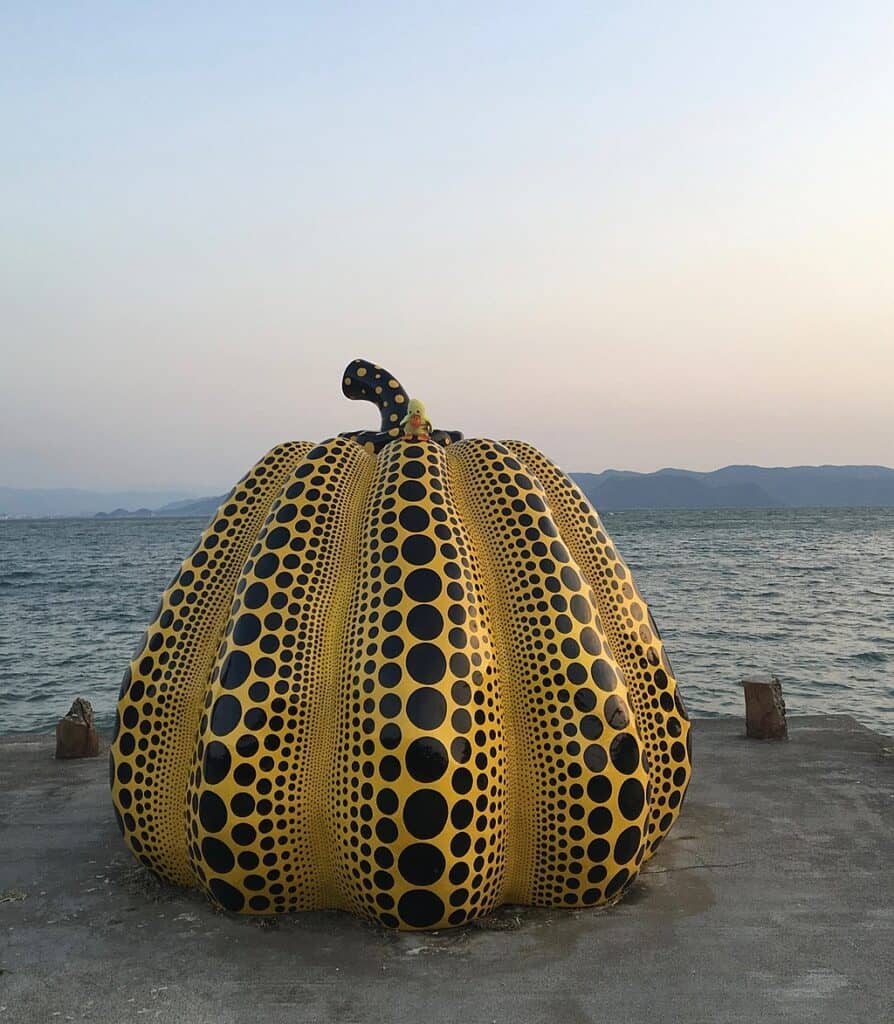
Yayoi Kusama is one of the most famous pattern artists alive today. She started developing her groundbreaking visual language in the 1950s with her Infinity Cyberspace paintings – fabricated entirely from repetitive semi-round brushstrokes creating lace-similar patterns that cover the canvas and suggest an expansion into infinity. In her words: "I would cover a canvas with nets, then go along painting them on the table, on the floor, and finally on my ain body. […] the nets began to expand to infinity. I forgot virtually myself as they enveloped me." This idea of infinity through repetitive patterns has been fundamental for Kusama's further artistic product. No matter the medium in which she creates, exist it painting or sculpture, Kusama e'er connected to employ the same motif: endless dots. The dots first came to her at age ten, when she had hallucinations in which she saw lite flashes, fields of dots and auras. Kusama successfully merges her own inner world with the exterior earth as her impressive, whimsical sculptures filled with her dots tin exist constitute all over the world.
vii. Damien Hirst
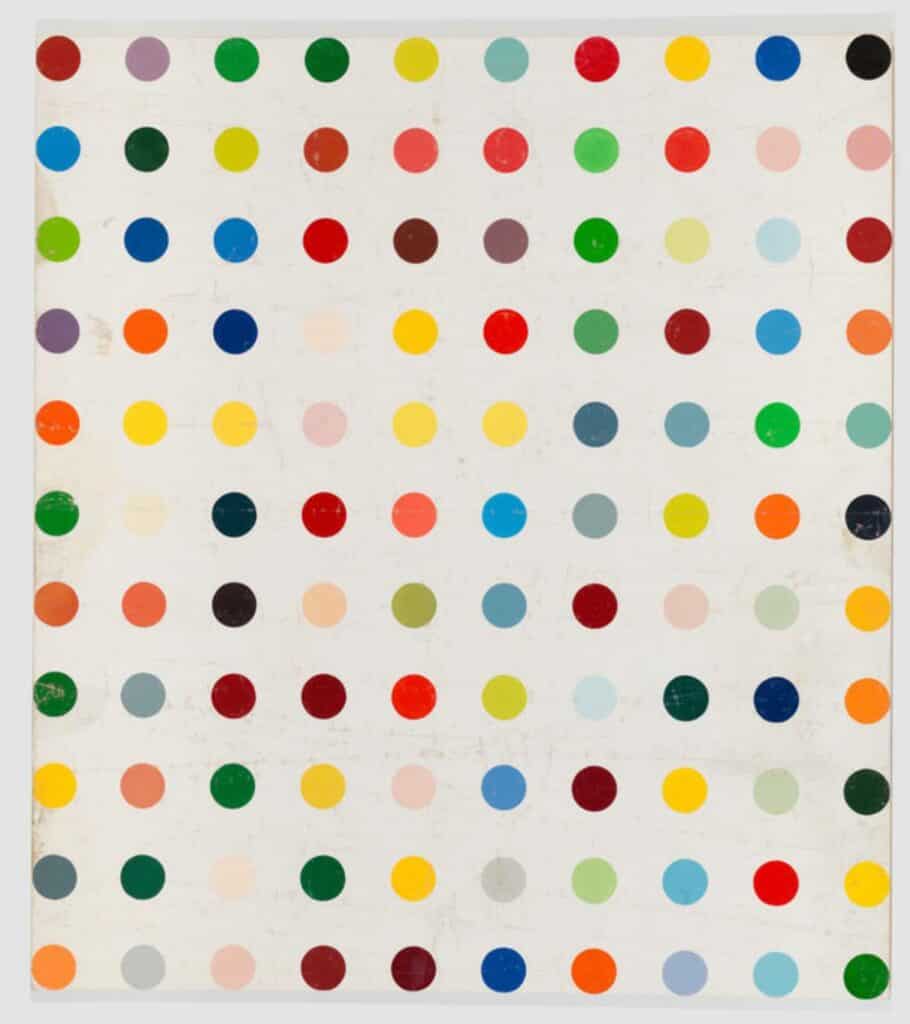
Damien Hirst, the most famous of the Immature British Artists (YBA), is some other lover of patterns and repetition in his fine art. Aside from his notorious formaldehyde works and his diamond skull, Hirst is known for his utilise of patterns. Serial such as his Kaleidoscope paintings (equanimous of thousands of butterfly wings placed in intricate patterns) and his Spot paintings (consisting of countless coloured spots) are Hirst's reply to the art of repetition. "I think y'all go meaning through repetition," Hirst explains. Of the xiii sub-serial in Hirst's Spot painting category, his Pharmaceutical paintings are his well-nigh prolific, with over 1000 of them in existence. Hirst works with assistants to produce these works, removing any physical testify of human intervention so that the works announced to take been synthetic mechanically.
viii. Sarah Morris
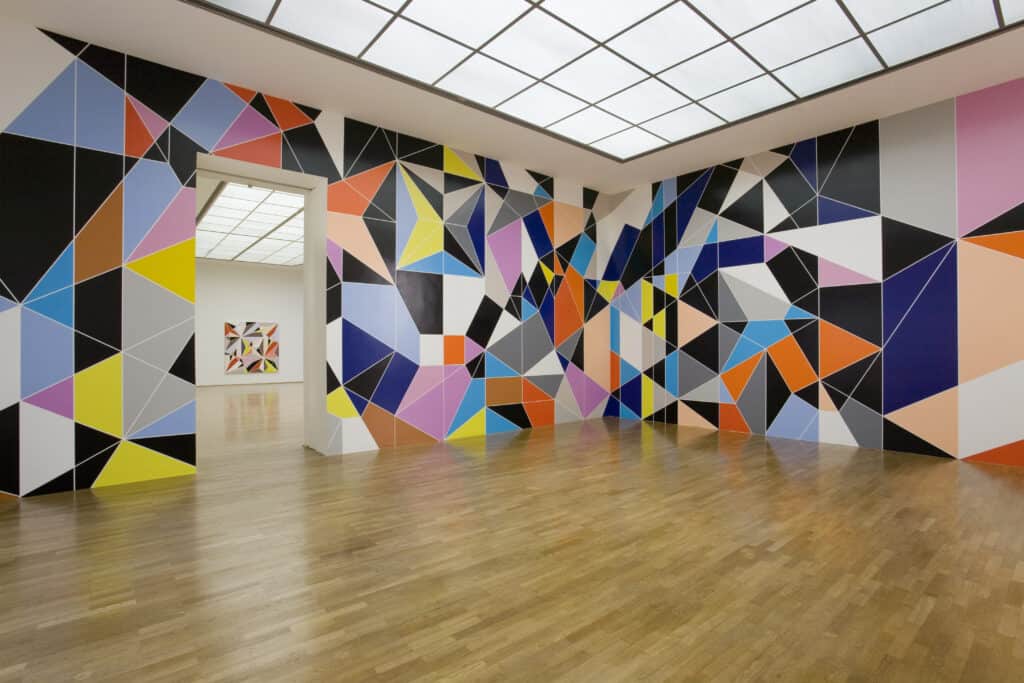
New York-based British artist Sarah Morris uses the strategies of compages (namely lark and calibration) to create her fascinating abstract paintings and films investigating "urban, social and bureaucratic typologies". Her works are based on different cities and stem from a close inspection of architectural details combined with Morris's sensitivity to the psychology of a city and its inhabitants. Her city-inspired paintings are created using household gloss paint on square canvases, and she employs rigorous, repetitive and often kaleidoscopic grid-forms referencing architectural motifs, signs or urban vistas. Through the bright colours she uses, each city'due south unique essence and dynamic is evoked.
9. Bridget Riley
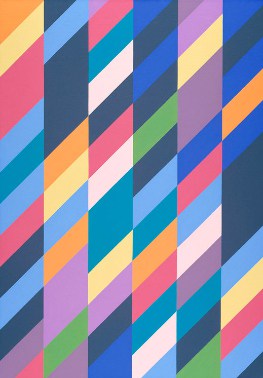
British artist and designer Bridget Riley is one of the virtually celebrated Op artists, using colours, shapes and patterns in such a fashion that an optical illusion is created. She became inspired to explore optical effects when studying Seurat's pointillism, some of whose works she too copied in immaculate particular. Riley's works combine clean lines, colour arrangements, geometric precision and repetitive patterns to create optically compelling visual furnishings. Of her piece of work, she in one case said: "The eye can travel over the surface in a way parallel to the style information technology moves over nature. It should feel caressed and soothed, feel frictions and ruptures, glide and drift. Ane moment, there will be nothing to wait at and the next second the canvas seems to refill, to be crowded with visual events."

10. Takashi Murakami
Nosotros conclude our list with Japanese artist Takashi Murakami, the proponent of the innovative "Superflat" aesthetic, which combines classical Japanese fine art with contemporary Japanese pop civilisation. Murakami works consistently with the repetition of the aforementioned or similar patterns and symbols, all exploring the links between traditional printmaking techniques and Japanese anime and manga. His visual iconography consists of images of candy-coloured cartoon-like characters – smiling flowers, colourful mushrooms and creatures with bulging eyes popping out at the viewer to cause an overflow of colours and cuteness. His fine art challenges the boundaries betwixt what is considered "high art" and "low art", bringing the aesthetic of advertisements and cartoons into the high-end gallery and museum world. Murakami's art of repetition extends perhaps the virtually of all the artists on this list to the world of consumerism through mass-produced items that he sells through his own company Kaikai Kiki Co. Ltd. In this sense, the repetition of Murakami's patterns is endless.
Relevantsources to learn more
Explore Yayoi Kusama's entire body of work in the electric current retrospective art Martin Gropius Bau in Berlin
Y'all may as well similar:
Superlative x Artworks To Become Yous in the Mood For Summer
Top 10 Most Iconic Fine art and Way Collaborations
Elevation ten: The World's Most Remote Art Installations
Top ten Pioneers of the shaped canvas
Source: https://magazine.artland.com/the-art-of-repetition-top-10-pattern-artists/
0 Response to "Best Patreats and Army Patterns in Art in the World"
แสดงความคิดเห็น