Name 4 Art Forms That Share Common Ground With Dance


Members of a contemporary trip the light fantastic toe boogie troop performing a group routine

Saman dance from Indonesia, the trip the light fantastic is characterized past its fast-paced rhythm and common harmony between dancers
Trip the light fantastic is a performing fine art course consisting of sequences of motion, either improvised or purposefully selected. This motility has aesthetic and often symbolic value.[nb one] Dance can exist categorized and described past its choreography, past its repertoire of movements, or past its historical period or place of origin.[4]
An important distinction is to be fatigued between the contexts of theatrical and participatory dance,[five] although these two categories are not always completely separate; both may have special functions, whether social, ceremonial, competitive, erotic, martial, or sacred/liturgical. Other forms of human move are sometimes said to have a trip the light fantastic-similar quality, including martial arts, gymnastics, cheerleading, figure skating, synchronized swimming, marching bands, and many other forms of athletics.
Performance and participation [edit]
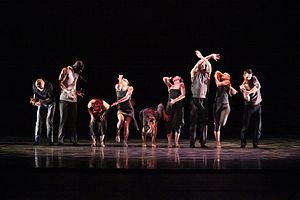
Members of an American jazz trip the light fantastic toe company perform a formal group routine in a concert dance setting
Theatrical dance, besides called performance or concert dance, is intended primarily equally a spectacle, usually a performance upon a stage past virtuoso dancers. It often tells a story, possibly using mime, costume and scenery, or else it may simply interpret the musical accompaniment, which is ofttimes especially composed and performed in a theatre setting only information technology is non a requirement. Examples are western ballet and modern trip the light fantastic, Classical Indian dance such every bit Bharatanatyam and Chinese and Japanese song and dance dramas such as dragon dance. Nigh classical forms are centred upon trip the light fantastic toe alone, but performance dance may as well appear in opera and other forms of musical theatre.
Participatory dance, on the other hand, whether it be a folk trip the light fantastic toe, a social trip the light fantastic, a group dance such as a line, circle, chain or foursquare trip the light fantastic, or a partner dance such as is common in Western ballroom dancing, is undertaken primarily for a mutual purpose, such every bit social interaction or practice, or building flexibility of participants rather than to serve any do good to onlookers. Such dance seldom has whatsoever narrative. A group trip the light fantastic toe and a corps de ballet, a social partner trip the light fantastic and a pas de deux, differ profoundly. Even a solo dance may exist undertaken solely for the satisfaction of the dancer. Participatory dancers ofttimes all employ the same movements and steps but, for example, in the rave culture of electronic dance music, vast crowds may engage in free trip the light fantastic, uncoordinated with those around them. On the other mitt, some cultures lay downward strict rules every bit to the detail dances in which, for example, men, women and children may or must participate.
History [edit]

Mesolithic dancers at Bhimbetka
Archaeological evidence for early trip the light fantastic includes nine,000-year-old paintings[ citation needed ] in Republic of india at the Rock Shelters of Bhimbetka, and Egyptian tomb paintings depicting dancing figures, dated c. 3300 BC. It has been proposed that before the invention of written languages, dance was an important part of the oral and operation methods of passing stories downwardly from one generation to the next.[6] The use of trip the light fantastic in ecstatic trance states and healing rituals (equally observed today in many contemporary "archaic" cultures, from the Brazilian rainforest to the Kalahari Desert) is thought to have been another early factor in the social development of dance.[seven]
References to dance tin can be found in very early recorded history; Greek trip the light fantastic (horos) is referred to by Plato, Aristotle, Plutarch and Lucian.[viii] The Bible and Talmud refer to many events related to trip the light fantastic toe, and contain over 30 dissimilar dance terms.[nine] In Chinese pottery as early as the Neolithic flow, groups of people are depicted dancing in a line holding easily,[ten] and the primeval Chinese word for "dance" is establish written in the oracle bones.[eleven] Dance is further described in the Lüshi Chunqiu.[12] [13] Primitive trip the light fantastic toe in aboriginal Prc was associated with sorcery and shamanic rituals.[fourteen]
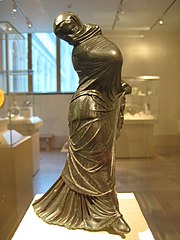
Greek bronze statuette of a veiled and masked dancer, 3rd–2nd century BC, Alexandria, Egypt
During the first millennium BCE in India, many texts were composed which attempted to codify aspects of daily life. Bharata Muni's Natyashastra (literally "the text of dramaturgy") is one of the earlier texts. Information technology mainly deals with drama, in which dance plays an important part in Indian culture. Information technology categorizes trip the light fantastic toe into 4 types--secular, ritual, abstract, and, interpretive--and into four regional varieties. The text elaborates various hand-gestures (mudras) and classifies movements of the various limbs, steps and so on. A stiff continuous tradition of dance has since continued in India, through to modernistic times, where information technology continues to play a part in culture, ritual, and, notably, the Bollywood entertainment manufacture. Many other gimmicky dance forms tin can also exist traced back to historical, traditional, ceremonial, and ethnic trip the light fantastic.
Music [edit]
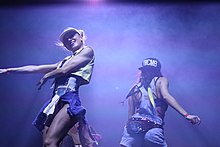
Dance is generally, nevertheless not exclusively, performed with the accompaniment of music and may or may not exist performed in time to such music. Some dance (such as tap trip the light fantastic toe) may provide its ain audible accompaniment in identify of (or in addition to) music. Many early on forms of music and dance were created for each other and are frequently performed together. Notable examples of traditional dance/music couplings include the jig, waltz, tango, disco, and salsa. Some musical genres have a parallel dance course such equally baroque music and baroque trip the light fantastic; other varieties of trip the light fantastic toe and music may share nomenclature just developed separately, such as classical music and classical ballet. The choreography and music go hand in paw, equally they complement each other to express a story told by the choreographer and or dancers.[xv]
Rhythm [edit]
Rhythm and dance are securely linked in history and practice. The American dancer Ted Shawn wrote; "The conception of rhythm which underlies all studies of the dance is something about which we could talk forever, and still not stop."[xvi] A musical rhythm requires 2 principal elements; first, a regularly-repeating pulse (likewise called the "beat" or "tactus") that establishes the tempo and, second, a pattern of accents and rests that establishes the character of the metre or bones rhythmic pattern. The basic pulse is roughly equal in duration to a simple step or gesture.

Dances by and large have a characteristic tempo and rhythmic pattern. The tango, for instance, is usually danced in 2
four time at approximately 66 beats per minute. The basic tiresome step, called a "slow", lasts for one shell, so that a full "right–left" pace is equal to one 2
4 mensurate. The basic forwards and astern walk of the dance is so counted – "slow-deadening" – while many additional figures are counted "slow – quick-quick.[17]
Just equally musical rhythms are defined past a pattern of potent and weak beats, so repetitive trunk movements often depend on alternate "stiff" and "weak" muscular movements.[18] Given this alternation of left-right, of forward-backward and rising-autumn, forth with the bilateral symmetry of the human being body, it is natural that many dances and much music are in duple and quadruple meter. Since some such movements require more time in one stage than the other – such equally the longer time required to elevator a hammer than to strike – some dance rhythms fall equally naturally into triple metre.[19] Occasionally, as in the folk dances of the Balkans, dance traditions depend heavily on more than circuitous rhythms. Farther, complex dances composed of a stock-still sequence of steps ever crave phrases and melodies of a certain fixed length to accompany that sequence.

Lululaund – The Dancing Daughter (painting and silk cloth. A.50. Baldry 1901, before p. 107), The inscription reads; "Dancing is a form of rhythm/ Rhythm is a form of music/ Music is a course of thought/ And thought is a form of divinity."
The very deed of dancing, the steps themselves, generate an "initial skeleton of rhythmic beats" that must take preceded any split musical accompaniment, while trip the light fantastic itself, every bit much equally music, requires time-keeping[20] just equally utilitarian repetitive movements such as walking, hauling and digging have on, as they become refined, something of the quality of dance.[18]
Musical accompaniment, therefore, arose in the primeval dance, then that ancient Egyptians attributed the origin of the dance to the divine Athotus, who was said to have observed that music accompanying religious rituals caused participants to motion rhythmically and to accept brought these movements into proportional mensurate. The same idea, that trip the light fantastic toe arises from musical rhythm, is still found in renaissance Europe in the works of the dancing primary Guglielmo Ebreo da Pesaro who speaks of dance as a physical motion that arises from and expresses inward, spiritual movement agreeing with the "measures and perfect concords of harmony" that fall upon the human ear,[eighteen] while, earlier, Mechthild of Magdeburg, seizing upon dance as a symbol of the holy life foreshadowed in Jesus' saying "I have piped and ye have non danced",[21] writes;
I tin can not dance unless thou leadest. If thou wouldst have me jump aloft, sing grand and I volition spring, into love and from love to knowledge and from knowledge to ecstasy above all human sense[22]
Thoinot Arbeau's celebrated 16th-century dance-treatise Orchésographie, indeed, begins with definitions of over eighty distinct drum-rhythms.[23]

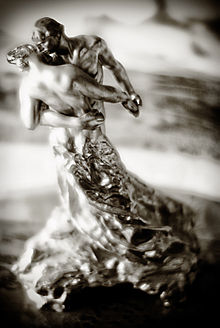
As has been shown to a higher place, trip the light fantastic toe has been represented through the ages as having emerged every bit a response to music yet, as Lincoln Kirstein unsaid, it is at least as likely that primitive music arose from dance. Shawn concurs, stating that dance "was the starting time art of the man race, and the matrix out of which all other arts grew" and that even the "metre in our verse today is a result of the accents necessitated by trunk movement, as the dancing and reciting was performed simultaneously"[16] – an assertion somewhat supported by the common use of the term "foot" to draw the key rhythmic units of poetry.
Scholes, non a dancer but a musician, offers support for this view, stating that the steady measures of music, of two, three or 4 beats to the bar, its equal and balanced phrases, regular cadences, contrasts and repetitions, may all be attributed to the "incalculable" influence of dance upon music.[24]
Émile Jaques-Dalcroze, primarily a musician and teacher, relates how a study of the physical movements of pianists led him "to the discovery that musical sensations of a rhythmic nature telephone call for the muscular and nervous response of the whole organism", to develop "a special training designed to regulate nervous reactions and effect a co-ordination of muscles and nerves" and ultimately to seek the connections betwixt "the fine art of music and the fine art of dance", which he formulated into his system of eurhythmics.[25] He concluded that "musical rhythm is only the transposition into sound of movements and dynamisms spontaneously and involuntarily expressing emotion".[26]
Hence, though doubtless, as Shawn asserts, "it is quite possible to develop the dance without music and... music is perfectly capable of standing on its ain feet without any assistance from the dance", even so the "2 arts will e'er be related and the human relationship can be profitable both to the dance and to music",[27] the precedence of one art over the other being a moot signal. The common ballad measures of hymns and folk-songs takes their name from dance, equally does the carol, originally a circle dance. Many purely musical pieces have been named "waltz" or "minuet", for example, while many concert dances have been produced that are based upon abstract musical pieces, such as two and 3 Part Inventions, Adams Violin Concerto and Andantino. Similarly, poems are frequently structured and named after dances or musical works, while trip the light fantastic toe and music accept both fatigued their formulation of "measure" or "metre" from poetry.
Shawn quotes with approval the argument of Dalcroze that, while the art of musical rhythm consists in differentiating and combining time durations, pauses and accents "co-ordinate to physiological law", that of "plastic rhythm" (i.e. trip the light fantastic) "is to designate motion in space, to translate long time-values by slow movements and brusk ones by quick movements, regulate pauses by their divers successions and limited sound accentuations in their multiple nuances by additions of actual weight, by means of muscular innervations".
Shawn even so points out that the system of musical time is a "man-made, artificial thing.... a manufactured tool, whereas rhythm is something that has e'er existed and depends on man not at all", beingness "the continuous flowing time which our homo minds cut up into convenient units", suggesting that music might be revivified past a render to the values and the time-perception of dancing.[28]
The early on-20th-century American dancer Helen Moller stated simply that "it is rhythm and form more than than harmony and color which, from the start, has bound music, poetry and dancing together in a union that is indissoluble."[29]
Approaches [edit]

Theatrical [edit]
Concert dance, like opera, more often than not depends for its large-calibration class upon a narrative dramatic structure. The movements and gestures of the choreography are primarily intended to mime the personality and aims of the characters and their role in the plot.[30] Such theatrical requirements tend towards longer, freer movements than those usual in non-narrative dance styles. On the other hand, the ballet blanc, developed in the 19th century, allows interludes of rhythmic trip the light fantastic that developed into entirely "plotless" ballets in the 20th century[31] and that allowed fast, rhythmic dance-steps such equally those of the petit allegro. A well-known example is The Cygnets' Dance in act two of Swan Lake.
The ballet developed out of courtly dramatic productions of 16th- and 17th-century French republic and Italy and for some time dancers performed dances adult from those familiar from the musical suite,[32] all of which were divers by definite rhythms closely identified with each dance. These appeared as graphic symbol dances in the era of romantic nationalism.
Ballet reached widespread vogue in the romantic era, accompanied by a larger orchestra and grander musical conceptions that did not lend themselves easily to rhythmic clarity and past dance that emphasised dramatic mime. A broader concept of rhythm was needed, that which Rudolf Laban terms the "rhythm and shape" of move that communicates grapheme, emotion and intention,[33] while only sure scenes required the verbal synchronisation of step and music essential to other trip the light fantastic styles, so that, to Laban, modern Europeans seemed totally unable to grasp the pregnant of "primitive rhythmic movements",[34] a state of affairs that began to change in the 20th century with such productions as Igor Stravinsky's The Rite of Spring with its new rhythmic language evoking primal feelings of a primitive past.[35]
Indian classical trip the light fantastic styles, like ballet, are oftentimes in dramatic form, so that there is a similar complementarity between narrative expression and "pure" trip the light fantastic. In this case, the two are separately defined, though not always separately performed. The rhythmic elements, which are abstract and technical, are known as nritta. Both this and expressive dance (nritya), though, are closely tied to the rhythmic system (tala). Teachers have adapted the spoken rhythmic mnemonic system called bol to the needs of dancers.
Japanese classical dance-theatre styles such every bit Kabuki and Noh, like Indian dance-drama, distinguish between narrative and abstract trip the light fantastic toe productions. The 3 main categories of kabuki are jidaimono (historical), sewamono (domestic) and shosagoto (dance pieces).[36] Somewhat similarly, Noh distinguishes between Geki Noh, based effectually the advancement of plot and the narration of activity, and Furyū Noh, trip the light fantastic toe pieces involving acrobatics, stage backdrop, multiple characters and elaborate stage action.[37]
Participatory and social [edit]
A contra dance, a form of participatory social folk trip the light fantastic toe with mixed European roots
Social dances, those intended for participation rather than for an audience, may include various forms of mime and narrative, but are typically set much more closely to the rhythmic pattern of music, so that terms similar waltz and polka refer every bit much to musical pieces as to the trip the light fantastic toe itself. The rhythm of the dancers' feet may fifty-fifty form an essential part of the music, every bit in tap trip the light fantastic toe. African dance, for example, is rooted in fixed basic steps, simply may too permit a high degree of rhythmic estimation: the feet or the torso marker the basic pulse while cross-rhythms are picked up by shoulders, knees, or caput, with the best dancers simultaneously giving plastic expression to all the elements of the polyrhythmic blueprint.[38]
Cultural traditions [edit]
Africa [edit]

Ugandan youth dance at a cultural celebration of peace
Dance in Africa is deeply integrated into social club and major events in a community are oftentimes reflected in dances: dances are performed for births and funerals, weddings and wars.[39] : xiii Traditional dances impart cultural morals, including religious traditions and sexual standards; give vent to repressed emotions, such as grief; motivate community members to cooperate, whether fighting wars or grinding grain; enact spiritual rituals; and contribute to social cohesiveness.[40]
Thousands of dances are performed around the continent. These may be divided into traditional, neotraditional, and classical styles: folkloric dances of a particular social club, dances created more recently in imitation of traditional styles, and dances transmitted more than formally in schools or individual lessons.[39] : 18 African dance has been altered by many forces, such as European missionaries and colonialist governments, who frequently suppressed local dance traditions as licentious or distracting.[40] Dance in contemporary African cultures nonetheless serves its traditional functions in new contexts; trip the light fantastic may celebrate the inauguration of a hospital, build community for rural migrants in unfamiliar cities, and be incorporated into Christian church building ceremonies.[40] [41]
Asia [edit]
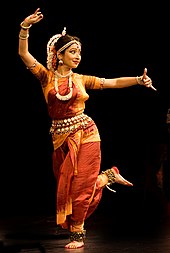
An Indian classical dancer
In the Mintha Theater (Mandalay) a master teacher of the Inwa School of Performing Arts demonstrates traditional hand movements.
All Indian classical dances are to varying degrees rooted in the Natyashastra and therefore share mutual features: for case, the mudrasouthward (paw positions), some body positions, leg movement and the inclusion of dramatic or expressive interim or abhinaya. Indian classical music provides accessory and dancers of nearly all the styles vesture bells effectually their ankles to counterpoint and complement the percussion.
There are now many regional varieties of Indian classical dance. Dances like "Odra Magadhi", which later on decades-long debate, has been traced to present day Mithila, Odisha region's trip the light fantastic form of Odissi (Orissi), indicate influence of dances in cultural interactions between different regions.[42]
The Punjab area overlapping India and Pakistan is the place of origin of Bhangra. It is widely known both as a style of music and a trip the light fantastic. It is more often than not related to ancient harvest celebrations, love, patriotism or social bug. Its music is coordinated by a musical instrument called the 'Dhol'. Bhangra is not just music but a trip the light fantastic toe, a celebration of the harvest where people trounce the dhol (pulsate), sing Boliyaan (lyrics) and dance. Information technology adult farther with the Vaisakhi festival of the Sikhs.
The dances of Sri Lanka include the devil dances (yakun natima), a carefully crafted ritual reaching far back into Sri Lanka's pre-Buddhist past that combines ancient "Ayurvedic" concepts of disease causation with psychological manipulation and combines many aspects including Sinhalese cosmology. Their influence can be seen on the classical dances of Sri Lanka.[43]

Indonesian dances reverberate the richness and diversity of Indonesian ethnic groups and cultures. There are more than than i,300 ethnic groups in Indonesia, it can be seen from the cultural roots of the Austronesian and Melanesian peoples, and various cultural influences from Asia and the due west. Dances in Republic of indonesia originate from ritual movements and religious ceremonies, this kind of dance usually begins with rituals, such as state of war dances, shaman dances to cure or ward off disease, dances to telephone call rain and other types of dances. With the acceptance of dharma organized religion in the 1st century in Indonesia, Hinduism and Buddhist rituals were celebrated in various creative performances. Hindu epics such as the Ramayana, Mahabharata and as well the Panji became the inspiration to be shown in a dance-drama chosen "Sendratari" resembling "ballet" in the western tradition. An elaborate and highly stylized dance method was invented and has survived to this day, especially on the islands of Java and Bali. The Javanese Wayang wong dance takes footage from the Ramayana or Mahabharata episodes, just this dance is very different from the Indian version, indonesian dances do not pay as much attention to the "mudras" equally Indian dances: even more to show local forms. The sacred Javanese ritual trip the light fantastic Bedhaya is believed to appointment back to the Majapahit flow in the 14th century or even earlier, this trip the light fantastic toe originated from ritual dances performed past virgin girls to worship Hindu Gods such equally Shiva, Brahma, and Vishnu. In Bali, dance has get an integral part of the sacred Hindu Dharma rituals. Some experts believe that Balinese dance comes from an older dance tradition from Java. Reliefs from temples in Eastward Java from the 14th century feature crowns and headdresses similar to the headdresses used in Balinese trip the light fantastic today. Islam began to spread to the Indonesian archipelago when indigenous dances and dharma dances were still popular. Artists and dancers still utilise styles from the previous era, replacing stories with more than Islamic interpretations and clothing that is more closed according to Islamic teachings.[44]
The dances of the Middle E are ordinarily the traditional forms of circumvolve dancing which are modernized to an extent. They would include dabke, tamzara, Assyrian folk dance, Kurdish dance, Armenian dance and Turkish dance, among others.[45] [46] All these forms of dances would usually involve participants engaging each other by holding hands or artillery (depending on the mode of the trip the light fantastic toe). They would brand rhythmic moves with their legs and shoulders every bit they curve around the dance floor. The head of the trip the light fantastic would generally concur a pikestaff or handkerchief.[45] [47]
Europe and North America [edit]
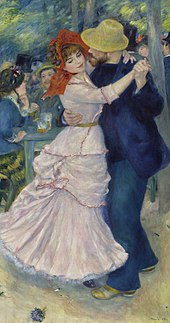
Folk dances vary across Europe and may date back hundreds or thousands of years, but many take features in mutual such every bit group participation led past a caller, mitt-holding or arm-linking between participants, and fixed musical forms known equally caroles.[48] Some, such as the maypole dance are common to many nations, while others such as the céilidh and the polka are deeply-rooted in a single culture. Some European folk dances such as the square dance were brought to the New Globe and later became part of American civilization.

Two classical ballet dancers perform a sequence of The Nutcracker, one of the best known works of classical trip the light fantastic.
Ballet developed first in Italy and so in France from lavish court glasses that combined music, drama, poetry, song, costumes and trip the light fantastic. Members of the court dignity took part as performers. During the reign of Louis Xiv, himself a dancer, trip the light fantastic became more than codified. Professional person dancers began to take the place of courtroom amateurs, and ballet masters were licensed by the French government. The beginning ballet dance academy was the Académie Royale de Danse (Royal Dance University), opened in Paris in 1661. Shortly thereafter, the first institutionalized ballet troupe, associated with the Academy, was formed; this troupe began every bit an all-male ensemble just by 1681 opened to include women as well.[6]
20th century concert trip the light fantastic toe brought an explosion of innovation in trip the light fantastic style characterized by an exploration of freer technique. Early on pioneers of what became known every bit modernistic trip the light fantastic toe include Loie Fuller, Isadora Duncan, Mary Wigman and Ruth St. Denis. The relationship of music to trip the light fantastic serves as the basis for Eurhythmics, devised past Emile Jaques-Dalcroze, which was influential to the development of Mod trip the light fantastic and modern ballet through artists such as Marie Rambert. Eurythmy, developed by Rudolf Steiner and Marie Steiner-von Sivers, combines formal elements reminiscent of traditional dance with the new freer manner, and introduced a complex new vocabulary to dance. In the 1920s, important founders of the new style such as Martha Graham and Doris Humphrey began their work. Since this time, a wide variety of trip the light fantastic styles have been developed; come across Modernistic dance.
African American trip the light fantastic toe developed in everyday spaces, rather than in trip the light fantastic studios, schools or companies. Tap dance, disco, jazz dance, swing trip the light fantastic, hip hop dance, the lindy hop with its human relationship to stone and roll music and rock and roll trip the light fantastic toe accept had a global influence. Trip the light fantastic toe styles fusing classical ballet technique with African-American dance have also appeared in the 21st century, including Hiplet.[49]
Latin America [edit]
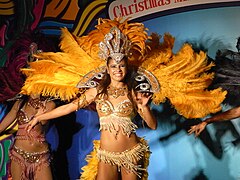
Street samba dancers perform in carnival parades and contests.
Dance is primal to Latin American social life and culture. Brazilian Samba, Argentinian tango, and Cuban salsa are internationally popular partner dances, and other national dances—merengue, cueca, plena, jarabe, joropo, marinera, cumbia, bachata and others—are important components of their respective countries' cultures.[50] Traditional Funfair festivals incorporate these and other dances in enormous celebrations.[51]
Dance has played an important role in forging a collective identity amid the many cultural and indigenous groups of Latin America.[52] Dance served to unite the many African, European, and ethnic peoples of the region.[fifty] Certain trip the light fantastic toe genres, such as capoeira, and body movements, especially the characteristic quebradas or pelvis swings, have been variously banned and celebrated throughout Latin American history.[52]
Education [edit]
Dance studies are offered through the arts and humanities programs of many higher educational activity institutions. Some universities offer Available of Arts and college academic degrees in Dance. A dance study curriculum may encompass a diverse range of courses and topics, including dance practice and functioning, choreography, ethnochoreology, kinesiology, dance notation, and dance therapy. Nearly recently, dance and motility therapy has been integrated in some schools into math lessons for students with learning disabilities, emotional/behavioral disabilities and/or attention deficit hyperactivity disorder (ADHD).[53]

A dancer practices in a trip the light fantastic studio, the primary setting for training in classical trip the light fantastic and many other styles.
Occupations [edit]
Dancers [edit]
Professional dancers are normally employed on contract or for particular performances or productions. The professional person life of a dancer is generally ane of constantly irresolute work situations, strong competitive pressure level and low pay. Consequently, professional dancers often must supplement their incomes to reach fiscal stability. In the U.S. many professional dancers belong to unions (such as the American Guild of Musical Artists, Screen Actors Guild and Actors' Disinterestedness Association) that establish working conditions and minimum salaries for their members. Professional dancers must possess large amounts of athleticism. To lead a successful career, it is advantageous to be versatile in many styles of trip the light fantastic toe, have a strong technical background and to utilize other forms of physical training to remain fit and healthy.[54]
Teachers [edit]
Dance teachers typically focus on teaching trip the light fantastic functioning, or coaching competitive dancers, or both. They typically have operation experience in the types of dance they teach or double-decker. For example, dancesport teachers and coaches are often tournament dancers or onetime dancesport performers. Dance teachers may exist self-employed, or employed by trip the light fantastic schools or general education institutions with dance programs. Some work for academy programs or other schools that are associated with professional classical dance (east.g., ballet) or modern dance companies. Others are employed past smaller, privately owned trip the light fantastic schools that offer trip the light fantastic toe grooming and performance coaching for diverse types of dance.
Choreographers [edit]
Choreographers are the ones that blueprint the dancing movements within a dance, they are oftentimes academy trained and are typically employed for particular projects or, more rarely may work on contract as the resident choreographer for a specific dance company.[55]
Competitions [edit]
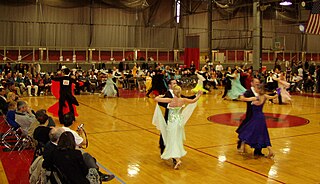
A dance contest is an organized outcome in which contestants perform dances before a judge or judges for awards, and in some cases, monetary prizes. In that location are several major types of dance competitions, distinguished primarily by the style or styles of dances performed. Major types of dance competitions include:
- Dancesport, which is focused exclusively on ballroom and latin dance.
- Competitive dance, in which a variety of theater trip the light fantastic styles, such as acro, ballet, jazz, hip-hop, lyrical, and tap, are permitted.
- Single-fashion competitions, such as; highland dance, trip the light fantastic squad, and Irish trip the light fantastic toe, that but permit a unmarried dance style.
- Open up competitions, that permit a wide variety of trip the light fantastic styles. An case of this is the Tv set program So You Think You Can Dance.
- Olympic, Dance has been trying to be role of the Olympic sport since 1930s.
In addition, there are numerous dance competitions shows presented on idiot box and other mass media.
Gallery [edit]
-

-

A gimmicky dancer performs a stag divide leap.
-
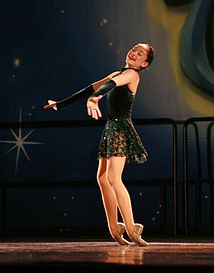
A dancer performs a "toe rise", in which she rises from a kneeling position to a standing position on the tops of her feet.
-
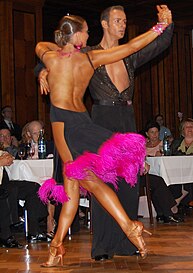
Latin Ballroom dancers perform the Tango.
-
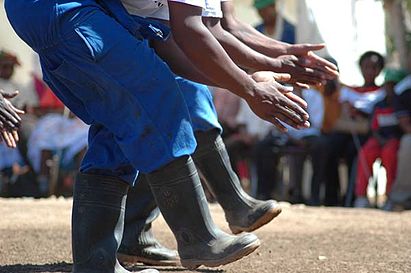
Gumboot trip the light fantastic toe evolved from the stomping signals used as coded communication betwixt labourers in S African mines.
-

-

-

Modern trip the light fantastic toe – a female person dancer performs a leg separate while balanced on the back of her partner.
-

A nineteenth century artist's representation of a Flamenco dancer
-

Ritual dance – Armenian folk dancers celebrate a neo-pagan new year's day.
-

A latin ballroom couple perform a Samba routine at a dancesport result.
-

Folk dance – some trip the light fantastic toe traditions travel with immigrant communities, as with this festival dance performed by a Polish community in Turkey.
-

Street dance – a Breakdancer performs a handstand pull a fast one on.
-

-

Ballet course of immature girls wearing leotards and skirts in 2017
-
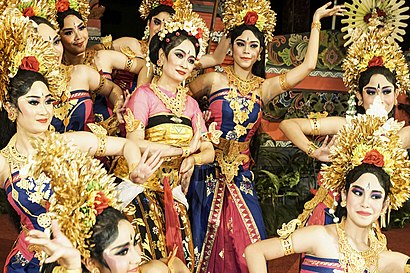
Come across as well [edit]
- Art
- Outline of performing arts
- Outline of trip the light fantastic
- Alphabetize of dance articles
- List of trip the light fantastic awards
- Human body
Notes [edit]
- ^ Many definitions of trip the light fantastic have been proposed. This definition is based on the following:
"Trip the light fantastic toe is human motility created and expressed for an aesthetic purpose."[1]
"Trip the light fantastic toe is a transient mode of expression performed in a given form and style by the human trunk moving in space. Dance occurs through purposefully selected and controlled rhythmic movements; the resulting phenomenon is recognized as trip the light fantastic toe both by the performer and the observing members of a given group."[2]
"Dance is homo behaviour composed (from the dancer's perspective, which is usually shared by the audience members of the dancer'southward civilization) of purposeful (individual selection and social learning play a role), intentionally rhythmical, and culturally patterned sequences of nonverbal torso movement by and large other than those performed in ordinary motor activities. The motion (in fourth dimension, space, and with effort) has an inherent and artful value (the notion of ceremoniousness and competency equally viewed by the dancer'southward civilization) and symbolic potential."[iii]
References [edit]
- ^ Sondra Horton Fraleigh (1987). Dance and the Lived Body: A Descriptive Aesthetics. University of Pittsburgh Pre. p. 49. ISBN978-0-8229-7170-2.
- ^ Joann Kealinohomoku (1970). Copeland, Roger; Cohen, Marshall (eds.). An Anthropologist Looks at Ballet as a Form of Ethnic Dance (PDF). What is Dance? Readings in Theory and Criticism (1983 ed.). New York: Oxford University Press. Archived from the original (PDF) on 2011-01-04.
- ^ Judith Lynne Hanna (1983). The performer-audience connectedness: emotion to metaphor in trip the light fantastic toe and society. Academy of Texas Press. ISBN978-0-292-76478-1.
- ^ Foster, Susan Leigh. (2011). Choreographing empathy : kinesthesia in performance. Routledge. ISBN978-0-415-59656-v. OCLC 963558371.
- ^ "Canadian National Arts Eye – Trip the light fantastic Forms: An Introduction".
- ^ a b Nathalie Comte. "Europe, 1450 to 1789: Encyclopedia of the Early Mod World". Ed. Jonathan Dewald. Vol. two. New York: Charles Scribner's Sons, 2004. pp 94–108.
- ^ Guenther, Mathias Georg. 'The San Trance Trip the light fantastic: Ritual and Revitalization Among the Farm Bushmen of the Ghanzi District, Republic of Botswana.' Periodical, South Due west Africa Scientific Lodge, five. 30, 1975–76.
- ^ Raftis, Alkis, The World of Greek Trip the light fantastic toe Finedawn, Athens (1987) p25.
- ^ Kadman, Gurit (1952). "Yemenite Dances and Their Influence on the New Israeli Folk Dances". Journal of the International Folk Music Council. 4: 27–30. doi:10.2307/835838. JSTOR 835838.
- ^ "Basin with design of dancers". National Museum of China. Archived from the original on 2017-08-11. Retrieved 2017-05-23 . Pottery from the Majiayao culture (3100 BC to 2700 BC)
- ^ Kʻo-fen, Wang (1985). The history of Chinese dance. Strange Languages Press. p. vii. ISBN978-0-8351-1186-7. OCLC 977028549.
- ^ Li, Zehou; Samei, Maija Bell (2010). The Chinese aesthetic tradition. Academy of Hawaiʻi Press. p. 5. ISBN978-0-8248-3307-7. OCLC 960030161.
- ^ Sturgeon, Donald. "Lü Shi Chun Qiu". Chinese Text Project Dictionary (in Chinese). Retrieved 2017-05-23 .
Original text: 昔葛天氏之樂,三人操牛尾,投足以歌八闋
- ^ Schafer, Edward H. (June 1951). "Ritual Exposure in Aboriginal China". Harvard Journal of Asiatic Studies. 14 (1/2): 130–184. doi:10.2307/2718298. ISSN 0073-0548. JSTOR 2718298.
- ^ "The Relationship Between Dance And Music || Dotted Music". Retrieved 2021-10-27 .
- ^ a b Shawn, Ted, Trip the light fantastic We Must, 1946, Dennis Dobson Ltd., London, p. 50
- ^ Imperial Order of Teachers of Dancing, Ballroom Dancing, Teach Yourself Books, Hodder and Stoughton, 1977, p. 38
- ^ a b c Lincoln Kirstein, Dance, Trip the light fantastic toe Horizons Incorporated, New York, 1969, p. 4
- ^ Shawn, Ted, Dance We Must, 1946, Dennis Dobson Ltd., London, p. 49
- ^ Lincoln Kirstein, Dance, Dance Horizons Incorporated, New York, 1969, p. 3
- ^ Matthew 11:17
- ^ Lincoln Kirstein, Dance, Dance Horizons Incorporated, New York, 1969, p. 108
- ^ Lincoln Kirstein, Dance, Trip the light fantastic Horizons Incorporated, New York, 1969, p. 157
- ^ Scholes, Percy A. (1977). "Dance". The Oxford Companion to Music (10 ed.). Oxford University Press.
- ^ Émile Jaques-Dalcroze, Rhythm, Music and Education, 1973, The Dalcroze Society, London, p. 8
- ^ Émile Jaques-Dalcroze, Rhythm, Music and Educational activity, 1973, The Dalcroze Society, London, p. 181
- ^ Shawn, Ted, Trip the light fantastic toe We Must, 1946, Dennis Dobson Ltd., London, p. 54
- ^ Shawn, Ted, Dance We Must, 1946, Dennis Dobson Ltd., London, pp. l–51
- ^ Moller, Helen and Dunham, Curtis, Dancing with Helen Moller, 1918, John Lane (New York and London), p. 74
- ^ Laban, Rudolf, The Mastery of Movement, MacDonald and Evans, London, 1960, p. 2
- ^ Minden, Eliza Gaynor, The Ballet Companion: A Dancer'southward Guide, Simon and Schuster, 2007, p. 92
- ^ Thoinot Arbeau, Orchesography, trans. by Mary Stewart Evans, with notes by Julia Sutton, New York: Dover, 1967
- ^ Laban, Rudolf, The Mastery of Move, MacDonald and Evans, London, 1960, pp. ii, 4 et passim
- ^ Laban, Rudolf, The Mastery of Move, MacDonald and Evans, London, 1960, p. 86
- ^ Abigail Wagner, A Different Type of Rhythm, Lawrence University, Wisconsin
- ^ "Kabuki « MIT Global Shakespeares". Retrieved April 8, 2015.
- ^ Ortolani, Benito (1995). The Japanese theatre: from shamanistic ritual to gimmicky pluralism. Princeton University Press. p. 132. ISBN978-0-691-04333-iii.
- ^ Ayansu, Due east.S. and Whitfield, P. (eds.), The Rhythms Of Life, Marshall Editions, 1982, p. 161
- ^ a b Kariamu Welsh; Elizabeth A. Hanley; Jacques D'Amboise (1 January 2010). African Dance. Infobase Publishing. ISBN978-1-60413-477-3.
- ^ a b c Hanna, Judith Lynne (1973). "African Dance: the continuity of change". Yearbook of the International Folk Music Council. five: 165–174. doi:10.2307/767501. JSTOR 767501.
- ^ Utley, Ian. (2009). Culture smart! Ghana customs & culture. Kuperard. OCLC 978296042.
- ^ Exoticindiaart.com, Dance: The Living Spirit of Indian Arts, past Prof. P.C. Jain and Dr. Daljeet.
- ^ Lankalibrary.com, "The yakun natima — devil dance ritual of Sri Lanka"
- ^ "The Indonesian Folk Dances". Indonesia Tourism. Archived from the original on 24 November 2010. Retrieved 30 November 2010.
- ^ a b Badley, Bill and Zein al Jundi. "Europe Meets Asia". 2000. In Broughton, Simon and Ellingham, Marking with McConnachie, James and Duane, Orla (Ed.), World Music, Vol. one: Africa, Europe and the Middle East, pp. 391–395. Rough Guides Ltd, Penguin Books.
- ^ Recep Albayrak Hacaloğlu. Azerbaijani cluster Türkçesi dil kilavuzu. Hacaloğlu, 1992; p. 272.
- ^ Subhi Anwar Rashid, Mesopotamien, Abb 137
- ^ Ballad Lee (2002). Ballet in Western Culture: A History of Its Origins and Evolution. pp. 10–11. ISBN978-0-415-94257-vii.
- ^ Kourlas, Gia (2016-09-02). "Hiplet: An Implausible Hybrid Plants Itself on Pointe". The New York Times. ISSN 0362-4331. Archived from the original on 2022-01-01. Retrieved 2016-12-03 .
- ^ a b John Charles Chasteen (ane January 2004). National Rhythms, African Roots: The Deep History of Latin American Popular Trip the light fantastic toe. UNM Printing. pp. 8–14. ISBN978-0-8263-2941-seven.
- ^ Margaret Musmon; Elizabeth A. Hanley; Jacques D'Amboise (2010). Latin and Caribbean Dance. Infobase Publishing. pp. 20–23. ISBN978-i-60413-481-0.
- ^ a b Celeste Fraser Delgado; José Esteban Muñoz (1997). Everynight Life: Culture and Dance in Latin/o America. Duke University Press. pp. 9–41. ISBN978-0-8223-1919-1.
- ^ "Dance/Movement Therapy's Influence on Adolescents Mathematics, Social-Emotional and Dance Skills | ArtsEdSearch". www.artsedsearch.org . Retrieved 2020-03-18 .
- ^ Sagolla, Lisa (April 24, 2008). "Untitled". International Bibliography of Theatre & Trip the light fantastic toe with Full Text. 15 (17): 1.
- ^ Risner, Doug (Dec 2000). "Making Dance, Making Sense: Epistemology and choreography". Inquiry in Dance Teaching. 1 (2): 155–172. doi:10.1080/713694259. ISSN 1464-7893. S2CID 143435623.
Further reading [edit]
- Abra, Allison. "Going to the palais: a social and cultural history of dancing and dance halls in Britain, 1918–1960." Contemporary British History (Sep 2016) xxx#3 pp. 432–433.
- Blogg, Martin. Dance and the Christian Faith: A Form of Knowing, The Lutterworth Press (2011), ISBN 978-0-7188-9249-4
- Carter, A. (1998) The Routledge Dance Studies Reader. Routledge. ISBN 0-415-16447-8.
- Cohen, Southward, J. (1992) Dance As a Theatre Fine art: Source Readings in Trip the light fantastic History from 1581 to the Present. Princeton Book Co. ISBN 0-87127-173-7.
- Daly, A. (2002) Disquisitional Gestures: Writings on Dance and Civilization. Wesleyan University Printing. ISBN 0-8195-6566-0.
- Miller, James, L. (1986) Measures of Wisdom: The Catholic Dance in Classical and Christian Antiquity, University of Toronto Press. ISBN 0-8020-2553-half dozen.
External links [edit]
- Chisholm, Hugh, ed. (1911). . Encyclopædia Britannica (11th ed.). Cambridge University Press.
- Historic illustrations of dancing from 3300 BC to 1911 Advertising from Project Gutenberg
- The states National Museum of Trip the light fantastic and Hall of Fame
Source: https://en.wikipedia.org/wiki/Dance
0 Response to "Name 4 Art Forms That Share Common Ground With Dance"
แสดงความคิดเห็น